[rt_reading_time label=”Reading Time:” postfix=”minutes” postfix_singular=”minute”]
Today, right here on this very page, I am going to show you a highly effective (but super simple) technique for developing new good habits and breaking old bad ones.
The method is very simple: to note down your progress each day. Just by doing this one simple thing, you’ll be far more likely to keep up with your habit.
So, without further ado, it is my pleasure to introduce the…

Consistency
When trying to develop a habit, it needs to be a consistent practice. Only once you’re used to doing it on a regular basis will it then require far less effort on your part to maintain. A study from 2009 showed that volunteers picked up new habits by completing them at the same time each day, so if you’re developing a fresh habit, try and complete it at the same time each day.
I understand that this whole thing can seem too simplistic to actually work, but using this method actually enabled me to finally stop smoking, refrain from biting my nails and even develop a habit of working on this blog each day – just try it for yourself. The worst case scenario is that you’ll end up back where you started.
Stuff You’ll Need
A printer, a bright green pen, a bright red pen, and some blu tack (or something similar for those of you in parts of the world that don’t have blu tack).

Download and Print
The first step is a super easy one: download the habit tracker from here, print it out, and put in down in front of you. Done? Good! Smashing it already.
The chart runs for 33 days because of a study that showed it takes an average of 66 days to form a new habit. The unstoppable James Clear talks about that in this article.
Choose What You Want To Track
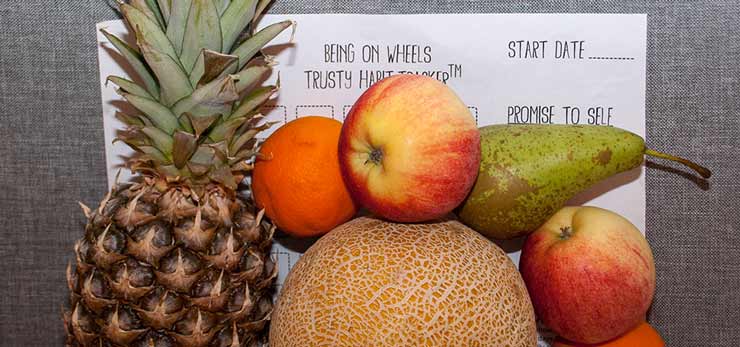
This will usually be a habit you plan to make or break: exercising or meditating, quitting smoking or drinking, spending less money or eating more fruit.
You need to decide what you’re trying to achieve each day: whether it’s doing thirty minutes of yoga practice, eating three pieces of fruit a day or not smoking any cigarettes.
Actually Doing It
The basic idea is that for each day of the month you write down the applicable number for whatever you’re trying to do. For example, if you managed to smoke no cigarettes, write a ‘0’ for the day, and if you managed the half an hour of exercise you were planning to do, write 30 for the day.
Here’s where the different coloured pens come in to play! If you’ve managed your goal, then use your nice bright green pen to write the number but if you haven’t, then it’s time to get out the sad red pen.
It seems a little silly but I find being able to write a nice green number is very satisfying and having to write an evil red one is very much not.
Keeping Yourself In Check
As you progress through the chart, it only strengthens your resolve to carry on. When you’ve managed a couple of weeks with only green numbers you’ll have a visual gauge showing your success so far, and every time you’re tempted to skip a day you’ll look at all of your green numbers and be more likely to get on and complete your task.
Even if you do miss a day (it does happen, working with habits is not easy), I find it just straightens your resolve even further on the following days, because when you look at your chart there’s a glaring red number staring back at you. This tends to have the effect of making you redouble your efforts so you can avoid putting any more red ink on your chart.
Make a Promise to Yourself
On the right-hand side of the chart, there is a section for you to write a promise to yourself; this is where you begin to make yourself accountable. You need to ask exactly why it is that you want to achieve this new habit and write it here.
Here’s what I wrote when I was using the habit tracker to stop smoking:
“I’m going to quit smoking. I know that it provides absolutely nothing good for me and yet I carry on doing it. I end up with coughs and colds way more often because I smoke, and I know it’s a total waste of money and health. In fact, there is absolutely no advantage to smoking whatsoever and so by starting this chart I’m making a promise to myself that I’m going to do everything I can to not smoke any cigarettes from this day forward.”

Writing this promise is useful for two main reasons. Firstly, having it written on your chart will remind you why you’re trying to work on your habit and increase your chances of succeeding.
The other reason is that when you feel like giving up or missing a day, you can re-read your promise as a reminder of why you wanted to keep up the habit in the first place.
Making It Even More Effective
Where To Place Your Chart
Stick the chart somewhere really obvious where you will see it all of the time, on the back of a door or on the wall at the foot of your bed (I put mine on the ceiling of the van). Doing this improves your chances of following through with your goal because it’s harder to ignore and it also helps keep what you’re trying to achieve in your awareness.
Tell Friends And Family
Another great way to hold yourself accountable is to let your friends and family know what you’re going to do, and if possible actually put your chart somewhere they’ll see it too, perhaps in a communal space like the kitchen. This will make it even harder for you to skip a day because you’ll be aware that they’ll be able to see your progress too. Sarah Doody has an interesting article about this idea from a more technical angle.

What If It Doesn’t Work?
If you’ve given this a go and you’re not happy with where you are with your habit, I invite you to view this as an opportunity to reflect on what progress you have managed so far. If you’ve made no progress whatsoever, then it could be worth asking yourself if you truly want to modify the habit. This technique will only work if it’s something you truly want to do.
As I’ve mentioned, it’s not easy to maintain a new habit and it takes time to ingrain it into your life, so try not to put too much pressure on yourself and just focus on improving on your previous efforts. I didn’t manage to totally give up smoking with the first habit tracker I used, but I got there in the end.
If you’re willing to keep repeating this process and you honestly do want to develop your habit, then there’s no real reason that this technique shouldn’t work. Habits are formed by repetition, and it’s as simple as that.
“Chains of habit are too light to be felt until they are too heavy to be broken.” – Warren Buffet (a super successful investor)
If you decide to give this one a go and start tracking a habit, chuck it in a comment and let’s get some good ol’ community feeling on this ‘ere blog post!
(Also, if you missed it at the top, here is the tick chart for downloading)
Looking for something else helpful along these lines, maybe find out about the pomodoro technique.


Leave a Reply